Business Model: Create, Deliver, and Capture Value
One that disrupts the existing economic order through the introduction of new products and services, the creation of new forms of organization, or the exploitation of new materials.
It was with the previous statement that Joseph Schumpeter defined entrepreneurship in 1949, and although more than seven decades have passed, the concept remains relevant. We live in a world where information circulates at an astonishing speed, and consumers are increasingly demanding. Business plans are essential tools for companies, but no business can succeed if it moves directly from idea/opportunity definition to the business plan. Any idea must be tested; otherwise, it remains merely a hypothesis, increasing the risk of business failure.
Professor Steve Blank, one of the ‘fathers’ of the Customer Development methodology that laid the foundations for the Lean Startup movement, stated that “no business plan survives first contact with a customer (…) while plans are static, business models are fully dynamic.” It is at this point that the concept of a business model becomes meaningful, as Alex Osterwalder and Yves Pigneur noted: “a business model defines how a company creates, delivers, and captures value.”
At its core, a business model aims to define how the viability and sustainability of a business idea are ensured. Only by defining the business model can we design strategies for the future.
There are many design thinking tools that help us work on business models, the most well-known being the Business Model Canvas (BMC), created by Alex Osterwalder and available on his platform www.strategyzer.com.
And your business model— is it disruptive?


Equipa Set.Up Guimarães
Últimas notícias

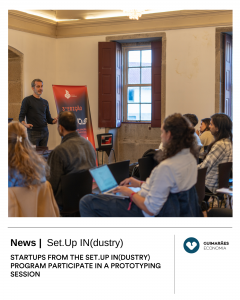
The acceleration program Set.Up IN(dustry) held another bootcamp yesterday, aimed at the startups selected for this edition, this time focused on Prototyping. The session was led by Júlio Martins, partner and co-founder of EVERYTHINK, co-founder of AVA, and founder of CASAL VADIO, with experience in management, design, innovation, and business strategy. He shared with the participants tools, methodologies, and best practices for developing prototypes of products and innovative solutions. The bootcamp focused on essential topics for startup growth, including concept definition, planning the prototyping process, and strategies for validating ideas and solutions in the market. Participants were encouraged to reflect on how to transform ideas into viable products and to apply the knowledge gained in the planning and development of future initiatives. Part of the Set.Up IN(dustry) acceleration program, promoted by Set.Up Guimarães, this bootcamp reinforces the municipality’s commitment to supporting the development of innovative industrial businesses, providing practical training and specialized mentorship. The program combines technical knowledge, networking, and personalized guidance, preparing startups to face market challenges and strengthen their presence within the entrepreneurial ecosystem. The Prototyping session provided another opportunity for participating startups to deepen critical skills to turn ideas into tangible and viable products, fostering innovation, experimentation, and continuous development. Initiatives like this highlight the role of Set.Up Guimarães in creating a solid, competitive, and forward-looking entrepreneurial environment, positioning Guimarães as a reference hub for innovation and industry.