
Innovating in Industry for a More Competitive and Innovative Portugal

Faced with an increasingly volatile future, both for the industrial sector and the startup ecosystem, it becomes essential to work upstream, ensuring interaction and collaboration among all stakeholders: industry; policymakers (government and municipalities); academic institutions (universities); and entrepreneurs and startups capable of identifying innovative solutions to existing market needs.
Rui, aqui está a tradução para inglês:
Since the first Industrial Revolution, industry has undergone profound transformations. Shifting priorities and procedures, technological advances have been introduced in areas such as information technology and engineering, leading up to the era of Industry 4.0, which reflects the structural and technological evolution that has taken place in the sector over the past 200 years.
In a phase marked by the transition to a new paradigm in the industrial ecosystem—strongly influenced by the sector’s digital transformation—so-called Industry 5.0 focuses on the collection and processing of data to improve efficiency and optimize human work (from the factory floor to administration), helping to design and implement well-supported strategies and, consequently, make better decisions.
At the same time, in the national entrepreneurial ecosystem, we hear increasingly about disruptive business ideas and terms such as unicorn startups, machine learning, artificial intelligence, or blockchain, with hundreds of entrepreneurship programs and contests being launched in Portugal to support the development of innovative products.
Thus, faced with an increasingly volatile future, both for the industrial sector and the startup ecosystem, it becomes crucial to work upstream, ensuring interaction and collaboration among all stakeholders: industry; policymakers (government and municipalities); academic institutions (universities); and entrepreneurs and startups capable of identifying innovative solutions to existing market needs.
As Guimarães is a municipality intrinsically linked to industry—particularly in textiles, cutlery, and metallurgy (sectors that have ensured the dominance of the secondary sector to this day)—it becomes important to develop programs that stimulate industrial innovation, supporting the transition to digital in a coordinated manner and involving all the actors mentioned above.
Inspired by the quintuple helix innovation model, which argues that innovation production should rely on five elements—companies, universities, government, civil society, and sustainability (ecology and environment)—the Municipality of Guimarães has been working, through projects such as Guimarães Marca and the Set.Up Guimarães startup incubators, to drive the transition from traditional industry to smart and environmentally sustainable factories. Through the creation of a true “industrial academy,” the focus also lies on upskilling workers in advanced knowledge areas linked to artificial intelligence, cybersecurity, e-commerce, robotics, and biotechnology, while promoting a new local economy based on better wages, improved quality of life, and the principles of social and environmental sustainability.
The work already developed in this context, within the municipality’s industrial sector, has focused on monitoring implemented industrial projects, evaluating areas such as Industry 5.0, robotics, the Internet of Things, sensorization, and sustainability in processes, materials, and resources used, also contributing to the transfer of critical knowledge produced in universities and research centers to local companies.
Based on this mapping, Set.Up IN(dustry) was born: an acceleration program for startups with innovative products or services for industrial applications. It has allowed participating startups to go beyond the purely educational component of such programs, enabling physical incubation within Guimarães’ industrial facilities and fostering a win-win relationship: startups gain access to workspace, tools, and know-how that help validate their business ideas, while industry benefits from collaboration with startups, accelerating its technological (and digital) innovation process and improving efficiency in strategic dimensions such as organization, people, processes, operations, and technology.
This is our aspiration for the coming year: the collaboration of all stakeholders for a more competitive—and above all, more innovative—Portugal.
Equipa Set.Up Guimarães
Últimas notícias
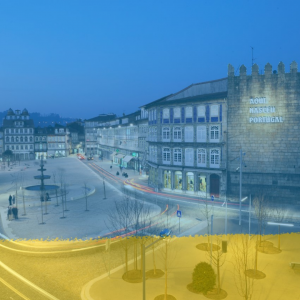
Guimarães develops solidarity campaign with the Ukrainian people
Campaign to raise goods in the municipality, promoted by the City Council, with the collaboration of the Guimarães Delegation
Read more.
Set.Up Guimarães present at the IX Employment and Entrepreneurship Fair, organized by the Nucleus of Chemistry Students of the Academic
Yesterday morning we were with the students of the Department of Chemistry of the University of Coimbra at the
Read more.
PRR: Regulamentado apoio para investigação e inovação na agricultura
O acesso a apoios do PRR para investigação, desenvolvimento e inovação na agricultura foi regulamentado por portaria ontem publicada, com
Read more.
Tens uma Ideia de Negócio? Então este projeto é para ti!
O projeto “Portugal Empreende 4.0”, Promovido pelo PORTUSPARK e pelo ISQ, e cofinanciado pelo COMPETE 2020, visa apoiar o empreendedorismo qualificado e fomentar a
Read more.